The doctor's credentials
Credential by credential: the official register, where one exists, the original documents and, where there is no register, a manual review.
Available

Medical tourism
From far away you cannot see the diploma of the person treating you, the clinic, or the qualifications of the staff at a wellness center. Here is what to ask, and how to check.

The phenomenon
Medical tourism means traveling to another country for a procedure, a treatment or a wellness program. In 2018, UNWTO (now UN Tourism) and the European Travel Commission wrote that health, wellness and medical tourism had “grown exponentially in recent years” and were becoming increasingly relevant in many destinations [1].
How large it is, nobody knows precisely: estimates differ widely between sources [1], and researchers in the field call for systematic data [2][3].
Meanwhile, travelers often have no simple way to check who is treating them, and where.
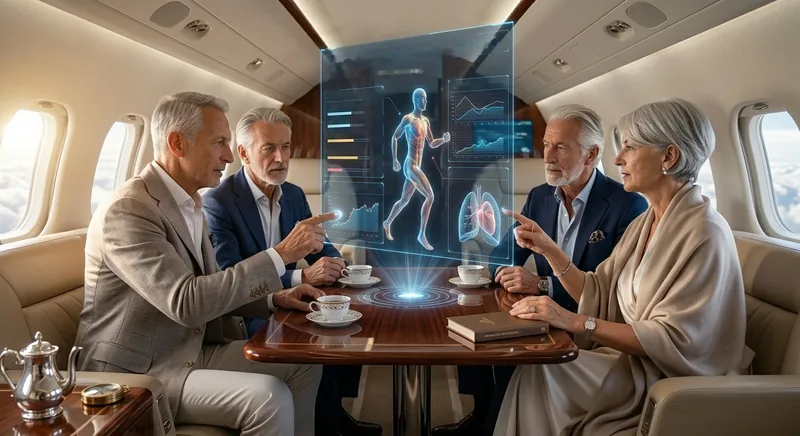
A cabin, a table, a trip to prepare: the questions come before takeoff.
You are right to ask them. They deserve an answer you can check, not a promise.
In some countries certain procedures, such as hair transplants, require a permit for the unit that performs them and a qualification for the person operating. Is that person really a doctor, qualified to do it?
An exam room and an operating room are not the same thing. Does the facility really exist? Is it authorized for that procedure?
Rules differ from place to place. Does the person looking after you really hold the qualifications they claim?
As far as we can tell, no single worldwide system checks the doctor, the facility and the wellness center together.
Each is designed to say what was checked, from which source and on what date. The label shows where each one stands.
Credential by credential: the official register, where one exists, the original documents and, where there is no register, a manual review.
Available
The documents that concern it: the company, the declared authorizations, the premises, the medical director. Checked with whoever issued them, where possible.
In preparation
The company, the authorizations, the staff qualifications and the courses on equipment and protocols. It is never a health authorization.
In preparation
The doctor
A copy of a diploma, however well made, does not tell you whether the diploma is real. The most reliable way is to ask the institution that issued it to confirm, rather than trust the copy you are shown.
Credential verification starts with the Swiss registers [4]; for other countries we say case by case what is possible. The profile is designed to tell you:
It is not a license to practice, and it does not say whether that doctor is right for your procedure.

A document that looks authentic is not enough.
Experts convened by UNESCO in July 2026 report that artificial intelligence has increased fraud involving qualifications.
The facility
A polished website cannot tell you whether a clinic exists. Documents can: the company, the authorizations it declares, its premises, the medical director's entry in the registers.
In the facility check, documents will be compared with whoever issued them, where possible. It is designed to give you three things:
SPA International
A massage, a morning in the pool, a stay far from home: you choose a wellness center from a website and a few photographs. And the qualifications of the people who look after you: who has checked them?
As far as we can tell, there is no single international register of the qualifications of people who work in wellness centers. There are voluntary standards, generally about the facility rather than the people, and different national or local rules. That is why a wellness center verification will have four steps: you will find them below.

In preparation
It will never be a health authorization: for anything medical, see a doctor.
That the center exists as a company, set up as it declares. The simplest question, and the first to ask.
Those the center declares, checked with whoever issued them, where possible. Rules differ from place to place.
The qualifications of the people who work at the center, compared with their diplomas and with those who issued them, where possible.
Courses on the center's equipment and protocols: that they were actually attended, and by whom.
Seal, credentials, look-alike domains: the mechanism of each, and where it stops.
If you have doubts about a diagnosis, a treatment plan or a consent form, we are designing Second Opinion Assist. The idea: a KSM doctor assesses the urgency, and the decision stays yours. Today it is not active and we do not take on real cases.
Not on its own. A register says a person is on it, not that their diploma is genuine, and each register applies to its own territory. For the diploma, the most reliable way is to ask the issuing institution to confirm it.
It is not enough. Where a country has an official portal for foreign patients, the list shows the facilities that have obtained that country's authorization. Being listed is not a promise of outcome. Absence is not proof: the facility may be unauthorized, or may simply not have applied to be included. Also check the authorization in the register of the country you are visiting, where one can be consulted.
Credential verification is live; we are building the one for facilities and wellness centers. What it means is already written. KSM verification is not an academic degree, a license to practice or a health authorization, and it is not an official recognition. It is a documented check of the credentials a person holds and declares, with the sources consulted and the date. For a facility or a wellness center the same applies, to the documents and authorizations it declares.
It depends where: rules are national or local and differ widely. As far as we can tell, there is no single international register of the qualifications of people who work there; voluntary standards exist, generally about the facility. Ask which qualifications the person looking after you holds.
Ask the institution that issued the qualification to confirm it, not the copy you are given. Look up the facility's authorization in the register of the country you are visiting, where one can be consulted. Ask which procedure it covers. If you choose a wellness center, ask which qualifications the person looking after you holds. Then talk to your own doctor.
It cannot tell you whether a procedure is right for you or how it will go: your doctor assesses that. It does not compare facilities, rank them or advise where to go. The verification concerns documents and authorizations.
We will tell you what you can already check yourself, and where our verifications stand. If the answer belongs to a doctor or an authority, we will point you to them.
Where we read the facts about this sector. There are no market figures here: the sources themselves say the data is fragmentary.